

Western Region Pisciculture Division
The incubation facility was built in 1958 as compensation for the construction of the Kaunas Hydroelectric Power Plant and was intended for the incubation of vimba bream and salmonid fish. At that time, it was the only artificial fish breeding facility in Western Lithuania. The location is particularly suitable for this activity, as it is surrounded by the waters of the Curonian Lagoon, the Nemunas River, the Atmata River and the Skirvytė River.
After the restoration of Lithuania’s independence, the facility assigned to the Rusnė Subdivision was in poor condition. The radiators were damaged by frost and cracked, the windows were broken, the pumping station was flooded with groundwater, and the main production hall contained only 15 five-metre-long tanks and a Weiss-type incubation rack.
Later, both the institutional subordination and the species bred at the facility began to change. Until 1995, the subdivision, then a department, was under the Ministry of Environment, and from 1997 it was transferred to the Ministry of Agriculture of the Republic of Lithuania. Its name also changed several times: Rusnė Fish Breeding and Acclimatisation Enterprise of the Curonian Lagoon Division, Rusnė Fish Breeding and Acclimatisation Station of the Curonian Lagoon Division, Rusnė Branch of the Lithuanian State Pisciculture and Fisheries Research Centre, and Rusnė Subdivision of the Fisheries Service under the Ministry of Agriculture of the Republic of Lithuania.
In Rusnė, various fish species were incubated, including pike, vimba bream, salmon, sea trout, pike-perch, burbot, bream, catfish and tench.
In 2004, the subdivision lost access to its ponds due to lengthy legal disputes with a co-owner holding a slightly larger share of ownership. In 2007, one recirculating aquaculture system was installed using European Union funds. Later, two production halls were developed from this system, where, for the first time, activities included not only fish incubation but also the rearing of newly hatched fish.
In 2007, four fish species were reared at the subdivision: 500 thousand pike-perch, 6 thousand catfish, 800 thousand tench and 2.7 million burbot.
In 2011, as part of an international programme, the subdivision began adopting Atlantic sturgeon breeding technologies. As a result, the rearing of burbot was discontinued. It should be noted that the conditions for rearing burbot were not ideal, as it was technologically impossible to reduce the temperature of borehole water to 0.5°C, or even to at least 2°C.
Due to the lack of both practical experience and theoretical knowledge in Atlantic sturgeon breeding, the initial stage was challenging. This process is illustrated by the following figures: in autumn 2011, 1,540 Atlantic sturgeon juveniles were released into the Neris and Šventoji rivers; in spring 2012, 178 juveniles were released; in autumn 2012, 5,600 juveniles; in spring 2013, 400 juveniles; in autumn 2013, 6,800 juveniles; in spring 2014, 1,200 juveniles; and in autumn 2014, 7,000 juveniles. In addition, 13,200 Atlantic sturgeon juveniles were transferred to the Simnas and Laukysta Subdivisions and sold to fisheries specialists in neighbouring Latvia.
These figures show that experience was gained over time. It should also be noted that Atlantic sturgeon released in spring are reared throughout the winter and, at the time of release, weigh on average slightly more than 400 grams.
In 2014, European Union funding was again received. Following reconstruction, a warehouse and garage were converted into a third recirculating aquaculture system facility, where Atlantic sturgeon are now being reared. Some of them are intended to be grown to broodstock stage.
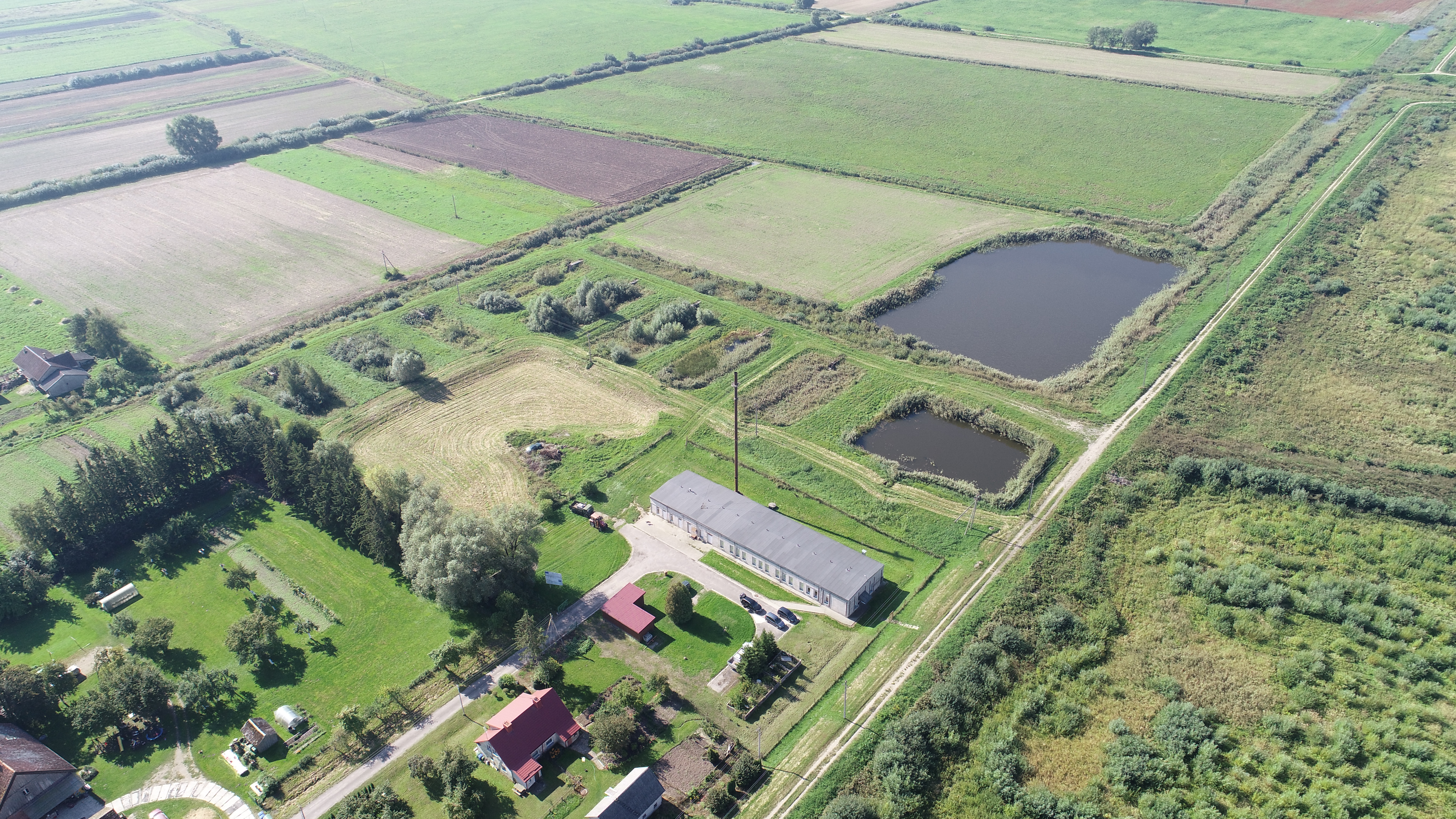
Rusnė, panoramic view, 2021
Last updated: 01-07-2026