

Trakų Vokė
The Trakų Vokė Subdivision is located on the site of a historic salmonid fish hatchery designed and established in 1880–1885, or according to some authors in 1884–1885, by Mykolas Kazimieras Girdvainis (1841–1924), the most prominent biologist and fisheries specialist in Lithuania at that time, who was also well known throughout Europe.
The Trakų Vokė salmonid fish hatchery was one of the first facilities of this kind in Lithuania. According to surviving historical data, an older salmonid fish hatchery in Lithuania may only have existed in Verkiai, established around 1870–1878.
M. K. Girdvainis chose the location for the Trakų Vokė fish hatchery deliberately. The hatchery was built during the flourishing period of the Trakų Vokė Manor, which at that time belonged to Jonas Tiškevičius, Marshal of the Nobility of Vilnius Governorate. As the hatchery was established on land belonging to the manor, it may be assumed that its design and construction were financed by the wealthy owner of the estate.
A spring-fed hollow was selected for the trout incubator and rearing ponds. All water required for the fish was supplied from natural springs. Even today, in the substantially reconstructed concrete trout ponds, the water temperature rarely exceeds 16°C, even during the hottest summer periods. Such conditions are ideal for breeding and rearing trout and other cold-water fish species.
Below the trout ponds, larger earth ponds were constructed. These warmed up more easily and were suitable for rearing cyprinid fish. In addition to rearing fish for the table of the nobility, M. K. Girdvainis carried out various fisheries studies and experiments in Trakų Vokė and kept detailed notes. Unfortunately, these notes disappeared during the First World War.
However, an archival project prepared by M. K. Girdvainis and implemented in 1881 has survived. It concerned a fish farm in Złoty Potok, in southern Poland, in the present-day Częstochowa region, which was very similar to Trakų Vokė and was also supplied by spring water. The project was financed by Count Edward Raczyński. This fish farm, which has changed little since its establishment, continues to successfully breed and rear rainbow trout and brown trout to this day.
Historical data show that in 1881 M. K. Girdvainis organised the transport of the first batch of rainbow trout eggs to Poland directly from the native range of this species, North America. The eggs were transported in wooden crates packed with ice and moist moss. Later, rainbow trout and their eggs were exported from Złoty Potok to many European countries.
As the Trakų Vokė fish hatchery was designed and built almost at the same time as the Złoty Potok facility, and in the absence of precise historical data, it can only be assumed that the first species bred at the Trakų Vokė hatchery was rainbow trout brought from Złoty Potok by M. K. Girdvainis.
Fragmentary historical data indicate that in 1885 M. K. Girdvainis stocked carp into the lakes of Trakai, possibly reared at the Trakų Vokė hatchery. In 1894, he stocked whitefish into the lakes of Trakai after incubating their eggs at the Trakų Vokė hatchery.
The Trakų Vokė fish hatchery operated successfully until the First World War and was particularly important for the development of fisheries in the Vilnius region. However, the First World War had a negative impact on the entire fisheries sector in Lithuania. The activities of the Trakų Vokė hatchery ceased in 1914, and the records of M. K. Girdvainis’s work disappeared.
Fisheries activities in Trakų Vokė were revived only in 1953, when the fish hatchery and its ponds were transferred to the Institute of Biology of the Lithuanian Academy of Sciences. The Experimental Base for Pisciculture and Fish Acclimatisation was established there, giving a significant impetus to the development of aquaculture research in Lithuania.
In 1959, this base was transferred to the newly established Institute of Zoology and Parasitology of the Lithuanian Academy of Sciences. At the Trakų Vokė experimental base, research was carried out on the breeding and rearing of various species and forms of trout, brook trout, salmon and carp. From 1960, research began on the breeding and rearing technologies of vendace and whitefish, and from 1962 on peled. Studies were also conducted on the natural food base of ponds.
During this period, many fisheries scientists worked at the Trakų Vokė experimental base, and a number of scientific works were prepared, laying the foundations for more efficient fish breeding and rearing. Academician Juozas Virbickas carried out his first scientific research here. Vytenis Sukackas, Juozas Bružinskas, Pranas Sinevičius, Andrius Astrauskas and other specialists who made significant contributions to applied fisheries science in Lithuania also worked at the base.
In 1963, after the Trakų Vokė fish hatchery was transferred from the Lithuanian Academy of Sciences to the production-oriented Inland Waters Exploitation Board under the Council of Ministers of Lithuania, and after the establishment of the Trakų Vokė Pisciculture Enterprise, its importance as a base for aquaculture research declined. The main focus shifted to production indicators in fish rearing.
Commercial rainbow trout and carp were bred and reared. Little attention was paid to investment in new fish breeding technologies or the renewal of the technical base.
Following major reforms in Lithuania’s fisheries management system, which began in 1988, the Trakų Vokė Pisciculture Enterprise was transferred in 1991 to the Agency for Fisheries Regulation and Pisciculture under the Department of Environmental Protection. In 1994, it was transferred to the State Pisciculture Centre under the Ministry of Agriculture. In 1998, this institution was renamed the Lithuanian State Pisciculture and Fisheries Research Centre.
During these reorganisations, no investment was made in the enterprise’s infrastructure. As a result, the historic nineteenth-century incubator gradually fell into disrepair. The trout ponds were used for rearing small quantities of rainbow trout juveniles brought from elsewhere to marketable size, while the earth ponds produced virtually no output. Attempts to incubate brown trout eggs in the neglected incubator were unsuccessful.
This created a situation in which the unique potential of the facility was not being used. There was no suitable place to incubate fish eggs, even though the cold-water ponds were highly suitable for keeping broodstock and rearing juveniles of trout, grayling and other cold-water fish species.
In 2007, a feasibility study on the use of the Trakų Vokė pisciculture complex concluded that it was necessary to restore and modernise the only pisciculture enterprise in Lithuania dedicated to native cold-water fish species, such as brown trout and grayling, by introducing and applying modern fish breeding technologies in production.
According to the study, the technological capacity of the enterprise should primarily be directed towards the breeding of brown trout and grayling. It was also proposed to develop and introduce artificial breeding and rearing technologies for other endangered species, including common nase, barbel and ide.
Taking into account the recommendations of the feasibility study, a technical project for the reconstruction of the incubator at Vinkšnų g. 6, Vilnius, Trakų Vokė, was prepared in 2008. Reconstruction works began in 2008, but after only a small part of the works had been completed, they were suspended in the first half of 2009.
In 2010, following the reorganisation of the Lithuanian State Pisciculture and Fisheries Research Centre, the Trakų Vokė fish hatchery was transferred to the Fisheries Service under the Ministry of Agriculture of the Republic of Lithuania.
In 2012, in implementation of Resolution No. 521 of the Government of the Republic of Lithuania of 16 May 2012, eight earth ponds with a total area of 8.42 hectares and most of the buildings were transferred to Vilnius City Municipality. The subdivision retained a land plot of 7.9253 hectares, including 13 cold-water concrete ponds with a total area of 90.97 ares, as well as the fish incubator and related auxiliary buildings and engineering systems.]
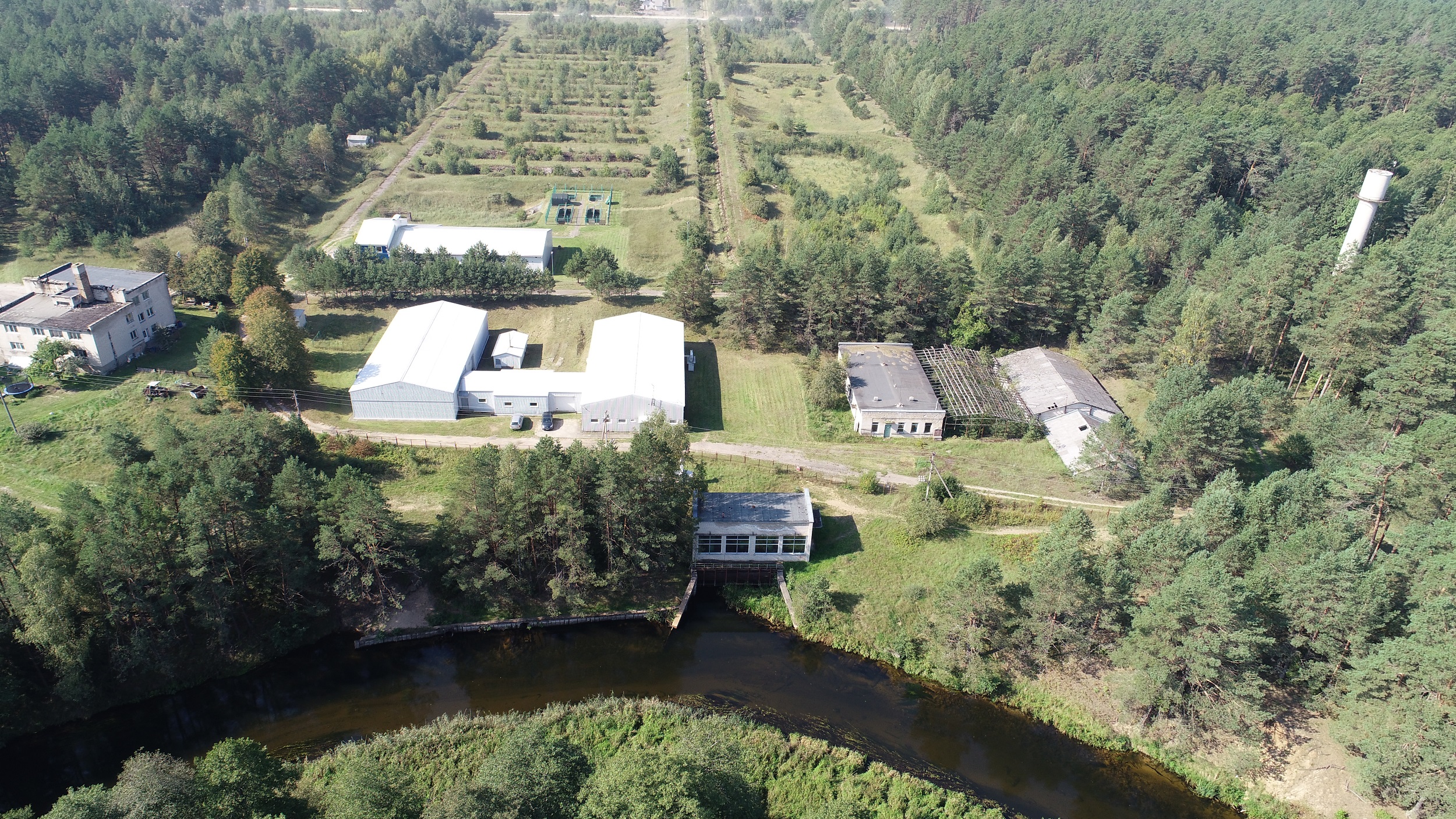
Trakų Vokė, panoramic view, 2021
Last updated: 01-07-2026