

Laukysta
The Kaunas Reservoir is the largest artificial water body in Lithuania, covering 6,400 hectares. It is used for commercial fishing and recreation, and therefore it is necessary to at least partially compensate for the impact caused to this water body by the Kruonis Pumped Storage Hydroelectric Plant. Since no fish passes to the Kaunas Reservoir and the upper reaches of the Nemunas River were installed during the construction of this hydropower plant, natural fish spawning conditions have significantly deteriorated due to water level fluctuations of 50–60 cm per day.
In order to preserve fish diversity in the Kaunas Reservoir and the Nemunas River basin and to restore stocks of valuable fish species, the Laukysta fish hatchery was assigned the task of breeding and rearing rare, endangered and other fish species. Acting in accordance with the regulations approved by order of the Minister of Agriculture of the Republic of Lithuania and other legal acts, specialists of the Laukysta hatchery maintain fish passage facilities and fish migration routes. They also prepare and implement investment projects, with the support of the European Union Structural Funds, aimed at improving migration and spawning conditions for protected and valuable fish species and increasing their resources.
The ponds at the hatchery were designed and constructed on the initiative and with the funds of the Lithuanian Hunters and Anglers Society before the restoration of Lithuania’s independence, in 1965–1972, and operated for more than 20 years. After the restoration of Lithuania’s independence, in 1992, the Government of Lithuania transferred the hatchery to the Ministry of Environment of the Republic of Lithuania, and in 1997 to the Ministry of Agriculture of the Republic of Lithuania. The hatchery was granted the status of a state enterprise, and in 2005 the State Enterprise Laukysta Fish Hatchery was reorganised into a budgetary institution.
The Laukysta Subdivision is located in a strategically convenient and attractive location, halfway between Vilnius and Kaunas, in Mančiūnai village, Žasliai Eldership, Kaišiadorys District Municipality. The ponds of this subdivision cover an area of 130 hectares. High-quality water is supplied to the ponds by gravity, and the fish incubator is being modernised.
Fish farmers from all over Lithuania come here to purchase juveniles of valuable fish species, including carp, grass carp, crucian carp, pike, bighead carp, pike-perch and tench. Every year in June and July, around 350 thousand reared pike-perch juveniles are released into non-leased water bodies. In October and November, 50–55 thousand pike fingerlings of the current year, weighing 50–100 grams, are stocked. The remaining juveniles are sold to natural and legal persons for their needs.
The Laukysta Subdivision is implementing the project “Implementation of the European Eel Management Plan in Lithuania”. The project activities aim to restore declining European eel resources, thereby contributing to environmental protection measures and the restoration of natural aquatic resources. The subdivision’s incubation facility is being adapted for the quarantine and temporary holding of European eels before their release into water bodies.
In 2013, a recirculating aquaculture system, hereinafter referred to as RAS, was commissioned for the temporary holding and quarantine of eels. In 2014, a heating system with a reverse-cycle function was installed to heat the incubation building and maintain the required water temperature in the RAS system.
Purchased glass eels are held and reared in the recirculating aquaculture system of the Laukysta Subdivision. Reared European eels are stocked in accordance with the Plan for the Stocking of Fish and Crayfish into State-Owned Water Bodies for which no permits to use fishing areas have been issued.
In 2014, 120 kg of glass eels were purchased, and 380.5 thousand reared eels were stocked into water bodies. The average weight of one eel was 1 gram. In 2015, 160 kg of glass eels were purchased, and 449.4 thousand reared European eels with an average weight of 1 gram were stocked. In 2016, 99.385 kg of glass eels were received, and 273.1 thousand reared European eels were stocked.
In 2016, while continuing the project “Restoration of European Eel Resources in Lithuania”, works were carried out in the incubation facility of the Laukysta Subdivision. These included insulation and finishing works on the building façade, roof insulation and installation of new roofing, installation of perimeter paving and walkways, interior finishing works, and the installation of a second recirculating aquaculture system for the temporary holding and rearing of glass eels.
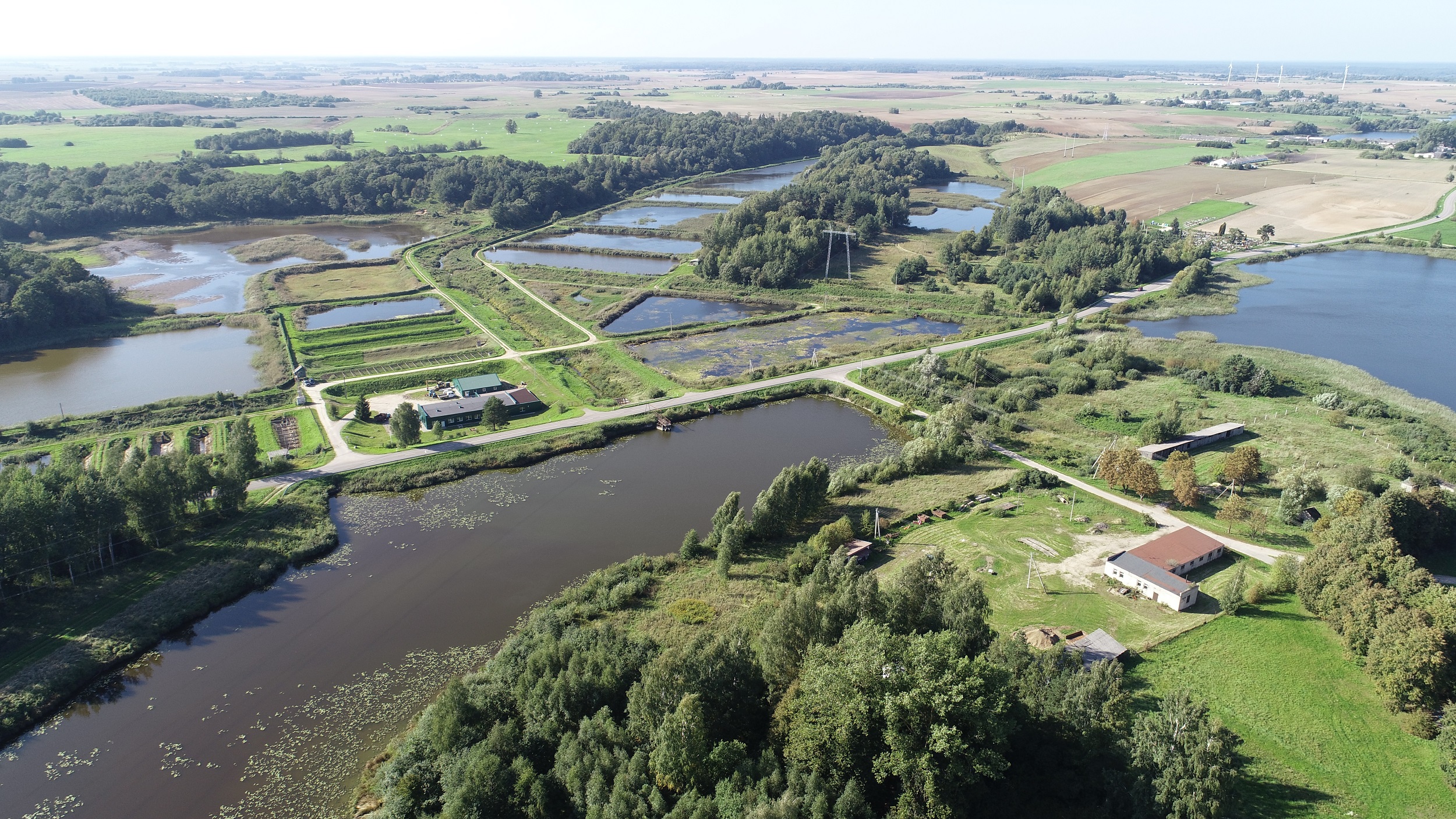
Laukysta, panoramic view, 2021
Last updated: 01-07-2026