

Simnas
When speaking about rivers, lakes and the fish living in them, we understand that this is an area in which part of the population has a wide range of interests. Fisheries is not only a business sector, but also one of the many ways in which people spend their leisure time. However, by intensively exploiting and altering the natural environment in order to meet human needs, we have disrupted the balance of natural factors that had developed over many years.
Among fish species, the greatest threat has arisen for those that can survive only in habitats of a specific structure and are sensitive to changes in water quality. At the same time, it is clear that reckless exploitation of fish resources may, within a very short period of time, bring certain fish species to the brink of extinction. Natural recovery of fish resources is difficult, and therefore artificial breeding is necessary. It is no coincidence that farms began to be established whose purpose was not the production of marketable fish, but the breeding of various fish species and the rearing of juveniles for the stocking of natural water bodies.
The Simnas pisciculture enterprise was established in 1964 as a hatchery for coregonid fish, mainly vendace. The following year, breeding activities for pike and carp were also launched. The enterprise itself is located on the southern outskirts of the town of Simnas. Its ponds are situated in the territory of Kalesninkai village.
The area of the enterprise belongs to the Lower Nemunas and Neris Plateau. In addition to the incubation facility, the subdivision has 48 ponds of various purposes, with a total area of more than 112 hectares. Depending on their purpose, the ponds differ in their morphometric and biological characteristics. Some are intended for fish overwintering, while others are used for rearing broodstock, juveniles and growing fish.
The ponds are supplied with water by the Spernia stream, which flows from Lake Dusia. The ponds are unique because all of them are filled by gravity, without the use of pumps.
In 2006–2007, reconstruction works were carried out in the incubation facility. A recirculating system was installed, including water heating, as well as mechanical and biological filtration. The water is heated to the required temperature and sterilised using UV filters. Water quality and suitability are also ensured by iron removal filters operating in automatic mode. The treated water is then returned to the system. This entire system creates optimal conditions for the spawning and rearing of various fish species.
Today, the Simnas Subdivision is the main breeding base in Lithuania for whitefish, European catfish and noble crayfish. In addition to the breeding and rearing of catfish, whitefish, peled, tench, pike, burbot, brown trout, rainbow trout, salmon, Siberian sturgeon and crayfish, the subdivision also participates in the Baltic sturgeon stock restoration programme.
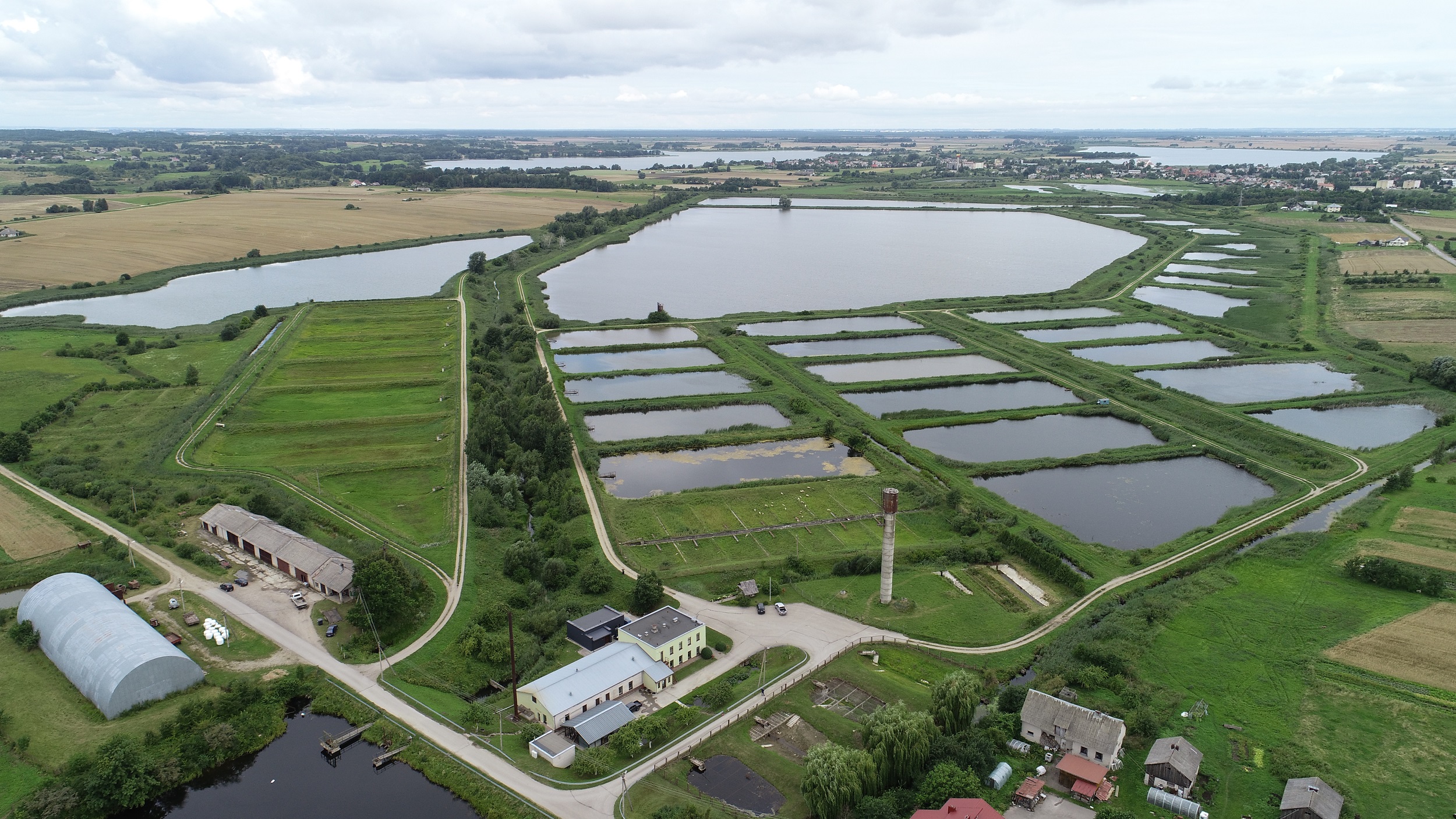
Simnas, panoramic view, 2021
Last updated: 01-07-2026